
 August 13, 2026
 by Jatin
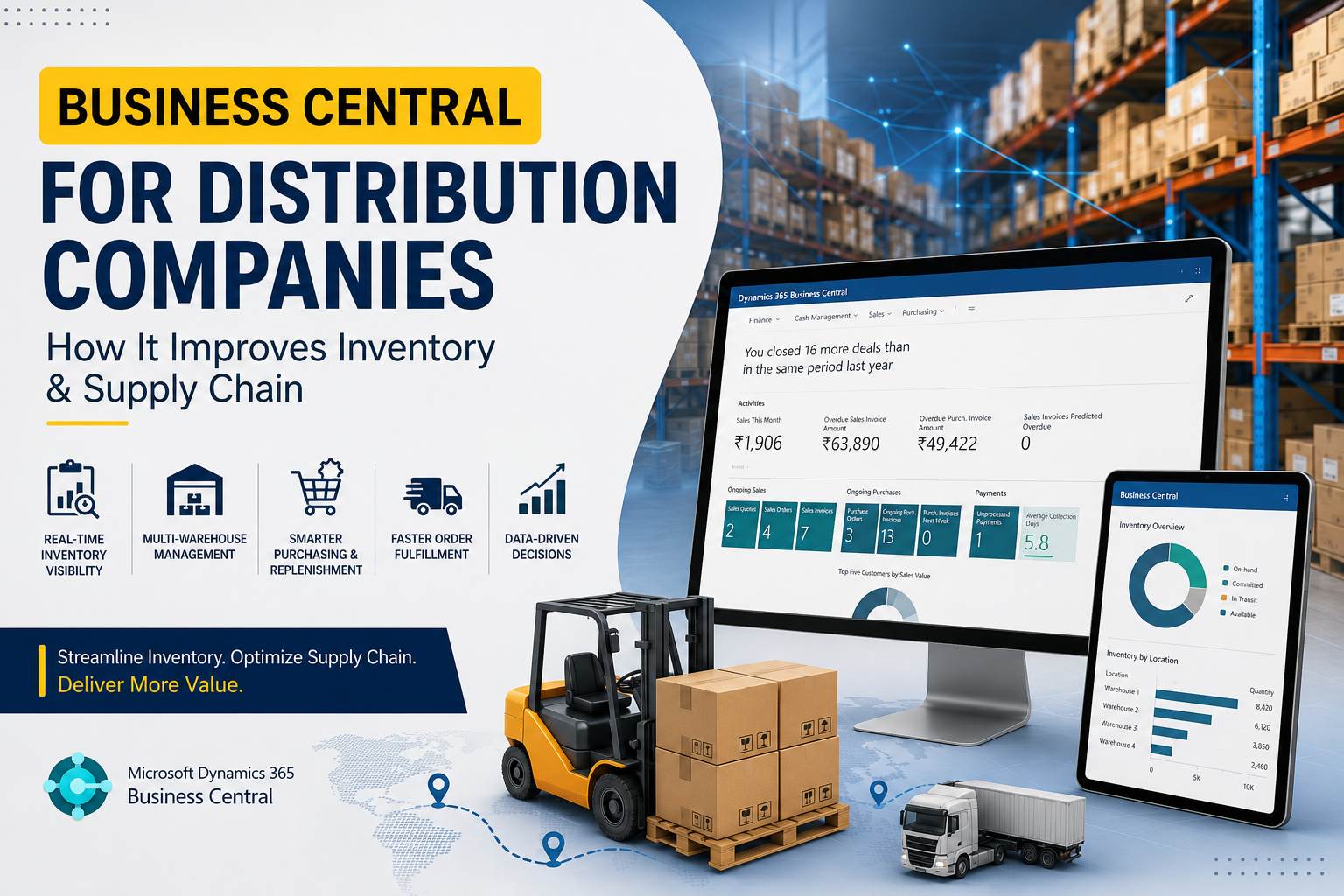
Microsoft Dynamics 365 Business Central for Distribution helps businesses connect purchasing, inventory, warehousing, sales, finance, and order fulfillment through one integrated ERP platform. For distributors managing multiple warehouses, large product catalogs, fluctuating demand, and complex supplier networks, the right ERP can significantly improve operational visibility and efficiency.
Distribution businesses often operate with tight margins. A small inventory planning error, delayed purchase order, stockout, pricing mistake, or inefficient warehouse process can directly impact profitability and customer satisfaction.
Business Central brings these processes together, helping distribution companies move from fragmented operations and spreadsheets toward a more connected, automated, and data-driven supply chain.
Why Distribution Companies Need a Modern ERP
The growing complexity of distribution operations
Distribution businesses need to manage much more than buying and selling products. They may handle thousands of SKUs, multiple warehouses, numerous suppliers, different lead times, customer-specific pricing, stock transfers, returns, and constantly changing demand.
When these processes are managed using spreadsheets or disconnected applications, businesses often struggle to answer important questions:
- How much inventory is available right now?
- Which warehouse has the required product?
- How much inventory is already committed?
- Which products need to be reordered?
- Which items are moving slowly?
- Which suppliers are delivering late?
- What inventory will be required next month?
Microsoft Dynamics 365 Business Central provides an integrated environment for sales, purchasing, inventory, warehouse operations, and financial management, giving teams a more complete view of business activity.
How Business Central Improves Inventory Management
Real-time inventory visibility
One of the biggest advantages of an ERP for distribution companies is centralized inventory visibility.
Business Central helps businesses track inventory movements across purchasing, sales, transfers, adjustments, and other transactions. Organizations can also manage inventory across multiple locations and track products using serial numbers, lot numbers, and other item-tracking methods where required.
This gives distribution managers better visibility into:
On-Hand Inventory → Incoming Stock → Committed Stock → Available Inventory → Future Demand
With better visibility, companies can make more informed purchasing decisions and reduce the risk of both overstocking and stockouts.
Multi-location inventory management
Many distributors operate multiple warehouses, branches, regional distribution centers, or stock points.
Managing these locations independently can create significant challenges. One warehouse may have excess inventory while another is experiencing a shortage.
Business Central enables organizations to manage inventory across multiple locations and transfer stock between warehouses when required.
For example, if a customer requires a product that is unavailable at the Delhi warehouse but available in Mumbai, the business can identify the available inventory and plan an internal transfer instead of unnecessarily placing a new purchase order.
This can improve inventory utilization while reducing unnecessary procurement costs.
Better stock availability planning
Inventory management isn’t only about knowing how much stock is available today. Distribution companies also need to understand how current inventory will change as sales orders, purchase orders, transfers, and other transactions occur.
Business Central helps organizations analyze supply and demand to identify potential shortages and surpluses.
This allows businesses to answer a critical question:
“Will we have enough inventory when the customer needs it?”
That makes inventory planning more proactive and reliable.
How Business Central Improves Supply Chain Management
Smarter purchasing and replenishment
Purchasing decisions directly affect inventory investment, customer service, and profitability.
Buying too much increases inventory carrying costs, while buying too little can result in stockouts and lost sales.
Business Central supports planning and replenishment by analyzing supply and demand information and helping businesses identify when additional inventory may be required.
Instead of relying completely on manual calculations and spreadsheets, procurement teams can use structured planning information to make better purchasing decisions.
Supplier and procurement visibility
A distributor may work with dozens or even hundreds of suppliers. Managing supplier pricing, purchase quantities, lead times, purchase orders, and purchasing history manually can quickly become complicated.
Business Central connects purchasing with inventory and financial information, helping procurement teams gain greater visibility into purchasing activities.
Businesses can analyze purchasing patterns, supplier performance, product costs, quantities, discounts, and purchasing history to make more informed procurement decisions.
This can also support better supplier negotiations and purchasing strategies.
Business Central for Warehouse Management
Improving receiving, picking, and shipping
Warehouse efficiency has a direct impact on distribution profitability.
A warehouse must receive products accurately, store them efficiently, pick the correct items, and ship customer orders on time.
Business Central provides warehouse management capabilities that can support processes such as receiving, picking, shipping, inventory movement, bins, and warehouse transfers.
By establishing standardized warehouse processes, distributors can reduce manual errors and improve operational consistency.
Better order fulfillment
Order fulfillment involves much more than creating a sales order.
The business must confirm inventory availability, allocate stock, pick the correct products, ship the order, and update inventory and financial records.
When these processes are disconnected, sales and warehouse teams may spend significant time manually checking inventory and reconciling information.
Business Central connects sales and inventory processes, helping organizations create a more streamlined order-to-delivery process.
How Business Central Helps Reduce Inventory Costs
Identifying excess and slow-moving inventory
Inventory that does not sell ties up working capital and consumes valuable warehouse space.
For distribution companies, slow-moving and obsolete inventory can become a significant financial problem.
Business Central provides inventory reporting and analysis capabilities that can help businesses identify stock movement and inventory performance.
This information can support decisions around:
Reordering → Stock Reduction → Promotions → Warehouse Transfers → Product Phase-Out
The objective isn’t simply to maintain more inventory.
The objective is to maintain the right inventory, at the right location, at the right time.
Business Central and Distribution Sales
Connecting sales orders with inventory
Sales teams need accurate inventory information before committing to customer orders.
If sales representatives cannot see reliable inventory availability, they may promise delivery dates that warehouse teams cannot meet.
Business Central connects sales and inventory information, allowing teams to make better-informed decisions about product availability and fulfillment.
This is particularly valuable for distributors competing on delivery speed and reliability.
Customer-specific pricing and order management
Distribution companies frequently work with different pricing structures based on customers, products, quantities, territories, contracts, or business agreements.
Business Central can centralize these commercial processes while connecting them with sales orders, inventory, purchasing, and finance.
This can reduce dependency on spreadsheets and manual pricing calculations.
Business Central for Supply Chain Visibility
From disconnected departments to one connected system
A common challenge in distribution businesses is that different departments operate with different information.
Sales may maintain one spreadsheet.
Purchasing may use another system.
Warehouse teams may rely on separate inventory records.
Finance may maintain its own data.
This creates information gaps and makes decision-making more difficult.
Business Central helps connect major business processes:
Sales → Purchasing → Inventory → Warehouse → Finance → Customer Delivery
This connected approach gives management a more comprehensive view of the supply chain.
Business Intelligence for Distribution Companies
Turning inventory data into business insights
Having inventory data is useful.
Understanding what the data means is even more valuable.
Distribution managers need to monitor inventory turnover, stock availability, purchasing trends, warehouse performance, sales activity, product profitability, and supply chain performance.
Business Central can work with Microsoft Power BI to create dashboards and visual reports that help management understand business performance.
This allows organizations to move from:
“How much inventory do we have?”
to:
“What is our inventory telling us about the business?”
That shift can help businesses make better decisions around working capital, purchasing, inventory, and customer fulfillment.
Key Business Central Features for Distribution
Inventory Management
Track products, stock movements, availability, costing, inventory levels, and multiple warehouse locations.
Purchasing Management
Manage suppliers, purchase orders, receipts, invoices, procurement processes, and purchasing information.
Sales Management
Manage customers, quotations, sales orders, shipments, returns, invoicing, and customer transactions.
Warehouse Management
Support receiving, picking, shipping, bins, transfers, and warehouse operations.
Supply Planning
Analyze supply and demand and support replenishment and inventory planning decisions.
Inventory Analytics
Monitor inventory availability, purchasing activity, stock performance, inventory value, and product movement.
Financial Management
Connect inventory and operational transactions with financial accounting, reporting, budgeting, and profitability analysis.
Who Can Benefit From Business Central for Distribution?
Wholesale distributors
Wholesale companies can use Business Central to manage large product catalogs, supplier relationships, purchasing, inventory, customer orders, and financial operations.
Import and export distributors
Businesses working with international suppliers and customers can benefit from centralized purchasing, inventory, sales, and financial management.
Multi-location distributors
Companies operating multiple warehouses or branches can gain better visibility into stock levels and inventory transfers.
Consumer goods distributors
Businesses managing high-volume SKUs can use inventory planning, sales management, warehouse capabilities, and analytics to improve fulfillment.
Industrial distributors
Distributors of machinery, electrical products, components, industrial equipment, and other technical products can benefit from detailed inventory tracking, purchasing, sales, and customer order management.
Why Choose Dynamics 365 Business Central for Distribution?
A scalable platform for growing distributors
As a distribution company grows, its operational complexity increases.
More customers mean more orders.
More products mean more inventory.
More warehouses mean more stock transfers.
More suppliers mean more procurement data.
More transactions mean greater financial complexity.
Business Central provides a foundation for connecting these processes within one ERP environment.
For businesses outgrowing spreadsheets, disconnected accounting software, or legacy ERP platforms, Business Central can provide a structured path toward more integrated distribution operations.
Frequently Asked Questions About Business Central for Distribution
What is Business Central for distribution?
Microsoft Dynamics 365 Business Central is an ERP platform that helps distribution companies manage finance, sales, purchasing, inventory, warehouse operations, and supply chain processes within an integrated business system.
Is Business Central good for wholesale distribution?
Yes. Business Central is well suited for wholesale and distribution businesses that need to manage purchasing, inventory, sales, warehouse operations, financial management, and customer fulfillment.
Can Business Central manage multiple warehouses?
Yes. Business Central supports inventory management across multiple locations and allows businesses to manage inventory transfers between warehouses.
How does Business Central manage inventory?
Business Central provides tools for tracking inventory levels, item movements, availability, purchasing, sales, transfers, inventory costing, and item tracking.
Does Business Central support inventory forecasting?
Business Central provides planning and replenishment capabilities that help businesses evaluate supply and demand and determine when additional inventory may be required.
Can Business Central help reduce excess inventory?
Yes. Inventory planning, availability analysis, reporting, and inventory analytics can help businesses identify excess, slow-moving, and potentially obsolete inventory.
Can Business Central integrate with Power BI?
Yes. Business Central can integrate with Power BI, allowing organizations to create interactive dashboards and analyze financial, sales, inventory, and operational data.
What is the best ERP for a distribution company?
The best ERP depends on the organization’s size, business model, number of warehouses, product complexity, operational requirements, integrations, budget, and growth plans. Microsoft Dynamics 365 Business Central is a strong option for many small and mid-sized distribution and wholesale businesses.
Final Thoughts
For distribution companies, inventory and supply chain efficiency are directly connected to customer satisfaction, working capital, and profitability.
A modern distribution ERP should do more than record purchases and sales. It should help businesses understand inventory availability, improve purchasing decisions, manage warehouses, fulfill customer orders, monitor stock performance, and connect operational activity with financial results.
Microsoft Dynamics 365 Business Central provides an integrated platform for these processes and can help growing distributors move from fragmented operations toward a more connected, efficient, and data-driven supply chain.
For businesses evaluating ERP software for distribution, wholesale distribution ERP, inventory management software, or a replacement for a legacy ERP system, Business Central can be an effective platform to consider.


